Thomas Struth German Born 1954 Art Institute of Chicago Ii Chicago 1990
Thomas Struth: Museum Photographs
Appearing at sale for the first time, Struth's iconic 'Art Institute of Chicago II, Chicago' from 1990 masterfully explores the boundaries between photography and painting.
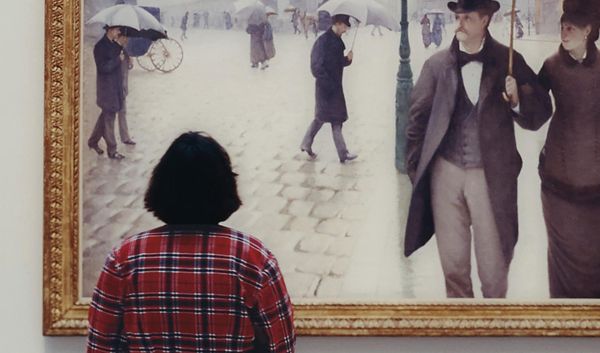
Detail of Thomas StruthArt Institute of Chicago 2, Chicago, 1990
In this autumn's edition of ULTIMATE, a unique platform for contemporary photography at Phillips, we are delighted to present Thomas Struth's masterwork Art Institute of Chicago II, Chicago, 1990, appearing at auction for the very first fourth dimension. Acquired straight from the artist in 1990, the same twelvemonth in which the work was created and first exhibited, this detail piece is number i from the sold-out edition of 10 and has been in the same individual collection for over 25 years.
Prints of this paradigm accept been acquired by numerous institutions including The Art Constitute of Chicago, Chicago; Hamburger Kunsthalle, Hamburg; and Astrup Fearnley Museet for Moderne Kunst, Oslo.
Art Institute of Chicago Two, Chicago, 1990, by Thomas Struth is a remarkable work from his first series of museum photographs, his best-known and virtually acclaimed body of piece of work in which Struth examines the socio-political dynamic of the museum and the viewer. While these photographs might resemble coincidental snapshots taken surreptitiously of visitors as they wander through a gallery, they are in fact highly deliberate. Wielding a large-format camera, Struth would spend hours, or even days, on each image. Every bit he set himself up in each location waiting for the right moment, visitors to the space would accept noticed him and his camera.
Struth's museum photographs ushered in a new visual language in photography.
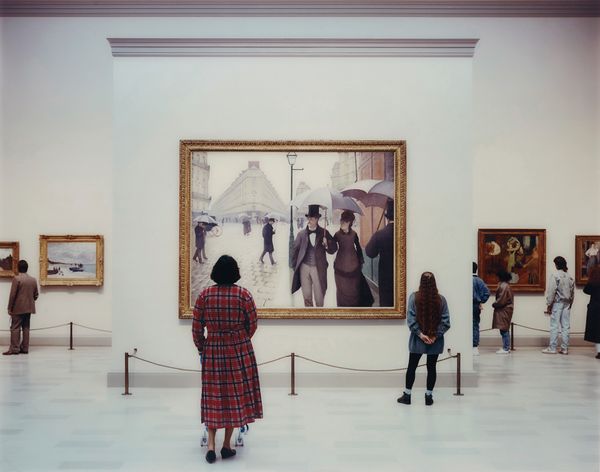
Thomas Struth Art Plant of Chicago II, Chicago, 1990
In investigating the human activity of viewing inside a museum context, Struth photographed the art and the visitors – the viewer looking at art and the viewer looking at other viewers. Through the multiple layers of viewing, Struth in turn examines the museum's means of control and representation, what they showroom and how, also as what narrative the museum provides for the work in relation to its setting. In his words, "the idea behind the museum photographs was to remember masterpieces from the fate of fame, to recover them from their status equally iconic paintings, to remind united states of america that these were works which were created in a contemporary moment, by artists who take everyday lives." By illustrating this through the photographic medium, Struth recalls the history of photography in relation to representation, and past viewing his work in a gallery setting, we are reminded of the photograph as a work of art.
Struth's museum photographs ushered in a new visual language in photography. Along with young man exponents of the Düsseldorf School of Photography, including Andreas Gursky, Candida Höfer and Thomas Ruff, Struth created new oversized color photographs – monumental in calibration and precision – that rivalled contemporary paintings. Applying new technical possibilities to create their piece of work, these practitioners collaborated with leading photographic laboratory Grieger in Düsseldorf to make their oversized prints and to frame them using the patented Diasec technique. Diasec face-mounting, whereby a photograph is bonded directly to acrylic glazing, enabled these artists to nowadays their large-scale photographs every bit contemporary fine art.
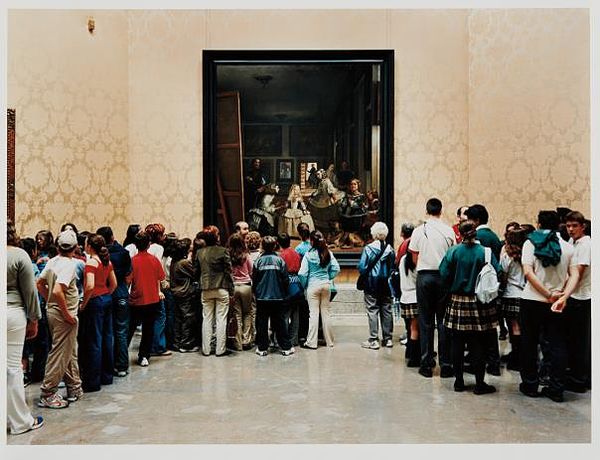
Thomas StruthMuseo del Prado Room 12, Madrid, 2005-2009
In the catalogue of the 2002-2003 travelling retrospective Thomas Struth 1977-2002, which included Art Plant of Chicago II, the NY Metropolitan Museum of Art'southward Maria Morris Hambourg and Douglas Eklund describe the work every bit "one of a number of museum photographs of exceptional poise, stillness, and spatial precision."Art Institute of Chicago II, 1990, features Gustave Caillebotte's Rue de Paris, temps de pluie [Paris Street, Rainy Day], 1877. Framing the work in the center of the epitome, Struth captures ii individuals as they contemplate the canvas. This Impressionist masterwork was one of the first paintings to draw the changing city of Paris as a event of its slap-up urban renovation commissioned past Napoleon Iii and directed by Baron Haussmann.
Struth's choice of painting likewise echoes his earlier black-and-white photographs of empty streets and architectural sites. This is not surprising equally Caillbotte is likely to have painted Rue de Paris, temps de pluie from a photograph or to emulate a photo. The detailed rendering of the edifice facades and the precipitous cropping of the man at the right edge of the foreground advise that this painting is an estimation of a photo. To create Art Institute of Chicago II, Struth has photographed a painting that in plow was painted to appear photographic thus underscoring the seemingly symbiotic relationship between painting and photography throughout the history of art.
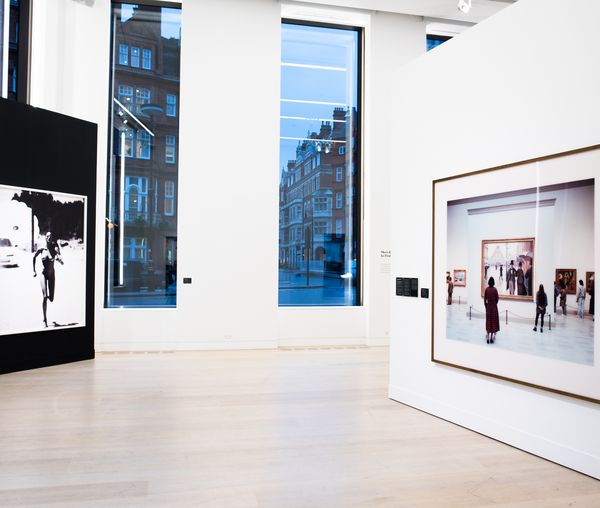
Installation view at Phillips Berkeley Foursquare featuring Struth's Art Constitute of Chicago Two, Chicago
With this work, Struth successfully bridges the gap – in both infinite and time – between the figures in the painting and the 2 figures viewing the painting in the gallery. The cobbled avenue in Caillebotte's piece of work appears to extend into the gallery space, enabling the couple to stroll out of the canvass, and in plow, the woman in the carmine tartan dress to push her pushchair into the canvass. "I wanted to bring together the fourth dimension of the picture and the time of the viewer," Struth explains. "I recollect what happened was that the artworks in my photographs became a little bit more than contemporary and the visitors were pushed back into history, because once I've photographed them, the moment has of grade already passed. It created this double reflection of consciousness."
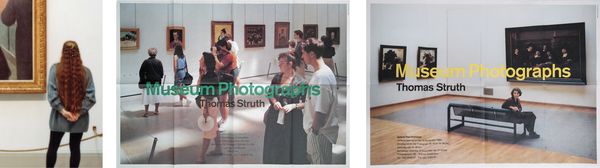
From left to right: Fig. 1, Item of Thomas Struth Art Institute of Chicago Two, Chicago, 1990; Fig. 3, Affiche for Galerie Giovanna Minelli exhibition, illustrated work: Musée d'Orsay, 1989; Fig. iv, Poster for Galerie Paul Andriesse exhibition, illustrated piece of work: Rijksmuseum Amsterdam I, 1990.
WhenArt Plant of Chicago II is displayed on a gallery wall, it functions to farther extend both space and time. The illusionary effect of Struth'south composition is that it drastically enlarges the infinite where it is hung. The viewer besides is invited to enter the layered "reflection of consciousness," as described past Struth, and follow the adult female with her pushchair into the painting. In decoding this multifaceted work, the viewer discovers other ways in which Struth links the painting with the two figures standing in front of information technology. Struth explains, "In my museum work, I wanted to connect with the paintings I chose in a particular way, through photographing groups of visitors corresponding with the figures in the paintings I photographed." In ane case, the plaited hair of the woman on the right and the aureate moulding of the frame next to which she stands create a visual rhyme (fig. 1). In another example, the assuming tartan pattern of the dress worn by the woman with the pushchair mimics not only the geometric shapes of the cobbled avenue in the painting merely also the line of the stanchion rope that designates the altitude between the painting and the viewers.
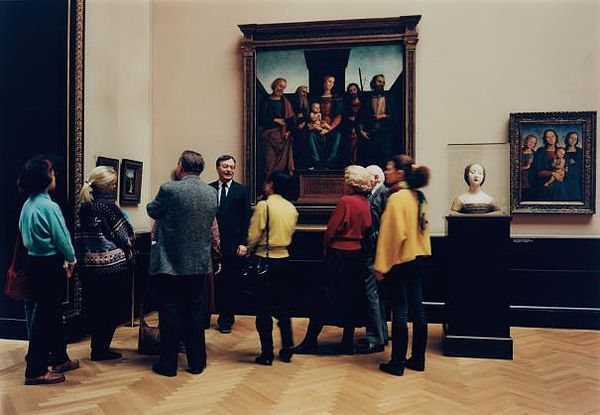
Thomas Struth Kunsthistorisches Museum Wien II, 1989
In belatedly 1990, the ground breaking outset exhibitions of Thomas Struth's museum photographs opened in v major galleries: Marion Goodman Gallery in New York (13 September – 13 October 1990), Galerie Giovanna Minelli and Urbi et Orbie Galerie in Paris (thirteen October – 17 November 199), Galerie Paul Andriesse in Amsterdam (xiii November – xv December 1990) and Galerie Meert Rihoux in Brussels (18 January - two March 1991). The shows opened first in New York, followed by Paris, then Amsterdam, and finally in early 1991, in Brussels. This impressive undertaking enabled Struth to oversee every installation and attend every opening, but too agree all five exhibitions within a period of a few months.
Struth himself engineered this collaboration and the participating galleries had piddling contact with each other. He selected the 5 venues in club to thematically exhibit the museum photographs based on where the photograph was taken or what was photographed. For instance, the Louvre and Musée d'Orsay images were shown in Paris, while the Art Institute of Chicago and Museum of Modernistic Art were shown in New York and the Rijksmuseum in Amsterdam. As many of the works were taken in Paris museums, Struth ensured they were shown in Paris and this was the but time that his works were exhibited at Galerie Giovanna Minelli and Urbi et Orbie Galerie. Struth produced the 5 posters for the shows himself, all with the same layout, all printed on Bible paper in Frg (fig. 3-4).
For Struth, this orchestrated first showing of his museum photographs was his style of extending the viewing space and time into the nowadays, adding all the same some other layer to the viewing experience.
Source: https://www.phillips.com/article/6911584/thomas-struth-museum-photographs
0 Response to "Thomas Struth German Born 1954 Art Institute of Chicago Ii Chicago 1990"
Post a Comment