Bleach Wallpaper Hd Lord of the Rings Mines of Moria Art
- "Orc is non an English language word. It occurs in one or two places [in The Hobbit] just is usually translated goblin (or hobgoblin for the larger kinds)."
- —J.R.R. Tolkien, Preface to The Hobbit
"Goblins" are what J.R.R. Tolkien called the Orcs whom Thorin and Company encountered in The Hobbit. They lived deep nether the Misty Mountains in many strongholds, always since the War of Wrath in the First Historic period. Tolkien described them as big, ugly creatures, "cruel, wicked, and bad-hearted." Tolkien explained in a note at the start of The Hobbit that he was using English to represent the languages used by the characters, and that goblin (or hobgoblin for the larger kind) was the English translation he was using for the discussion Orc, which (he wrote) is the hobbits' form of the proper noun for them. Tolkien used the term goblin extensively in The Hobbit, and also occasionally in The Lord of the Rings, as when the Uruk-hai of Isengard are kickoff described: "four goblin-soldiers of greater stature".
A clear illustration that Tolkien considered goblins and orcs to be the same thing, the former word only beingness the English translation of the latter, is that in The Hobbit (the but one of Tolkien's works in which he usually refers to orcs as goblins) Gandalf asks Thorin if he remembers Azog the goblin who killed his grandfather Thror [1], while in all his other writings Tolkien describes Azog every bit a "great Orc".[2]
History & description
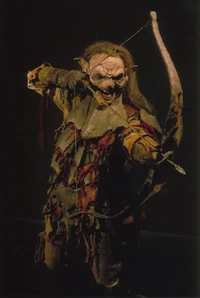
When Melkor was taken in chains to Valinor, the Orcs and other foul creatures were forced to flee from Angband. Their kingdoms spread throughout many mountains of Centre-earth; notable cities include Goblin-town about the Loftier Pass above Rivendell, the Goblin-capital at Mount Gundabad, and the former Dwarf-kingdom of Moria, equally well as those in the service of Isengard and Mordor.
Engineering science
Even though goblins are portrayed as a very barbaric and tribal race their engineering seems to exist more than advanced than other races in heart earth. In The Hobbit, Tolkien describes goblins as having dark engineering science. In the chapter "Over Hill and Under Hill" Tolkien states, "It is non unlikely that they invented some of the machines that have since troubled the world, specially the ingenious devices for killing large numbers of people at once, for wheels and engines and explosives ever delighted them."
Appearance

In The Hobbit, Tolkien describes Orcs as a large variety of goblins, leading some to the notion that mount goblins were of smaller build than Orcs, although the Great Goblin and "Azog the Goblin" (as he was called in The Hobbit) were massive in size.
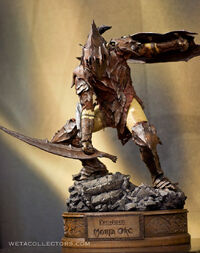
A heavily armed Goblin warrior as conceived for The Lord of the Rings films
Portrayal in adaptations
In popular parlance, perhaps because the word goblins was used in The Hobbit (which was in many ways essentially a children'southward book) whereas orcs came beyond equally more fearsome in Tolkien'due south afterward works, it has become mutual for many to distinguish goblins as different from orcs: smaller and less fearsome, and less socially evolved. This idea has gained currency through its widespread adoption in various adaptations of Tolkien's stories, as well equally in many derivative fantasy worlds, including novels, movies, and games such equally Dungeons & Dragons.
The Hobbit (1977 moving-picture show)
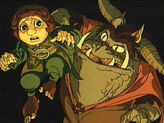
The strange fauna-like Goblins from the 1977 film
The blithe Goblins appearing in this motion picture are big, putrid green, bestial creatures. They are far bulkier than what one normally expects for a Goblin, being either hugely muscular or fat. They also had bulbous toad-similar heads featuring tusks, lupine ears, canine-like noses, and even horns.
The Return of the Male monarch (1980 motion-picture show)
This 1980 blithe film attempted to explicate to viewers the identification of goblins with orcs. Early in the moving picture, Sam is heard thinking, "Orcs in the belfry. Onetime Bilbo called them goblins. Whatever the proper noun, I loathe the vile creatures." The Goblins/Orcs in this film employ much the aforementioned blueprint every bit those seen in The Hobbit, but with more variations in shape and size, and a more than blue skin tone.
The Lord of the Rings film trilogy
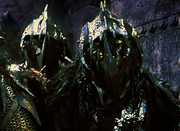
Scavenging Goblins
In Peter Jackson'due south film The Fellowship of the Ring (2001), Goblins have overrun the dwarven colony in Moria long before the events of the movie. When the Fellowship passes through the abandoned Dwarf city of Dwarrowdelf, Pippin accidentally alerts the Goblins to their presence, causing a fight to break out in Balin's Tomb. In this instance, their chief weapon appears to exist a Cave Troll, which has to exist brought down past the whole Fellowship, but the entire force is wiped out by the end of the boxing.
However, the skirmish allows a much larger strength of Goblins to shut in on the Fellowship, who abscond to the Bridge of Khazad-dûm. Unfortunately for them, even more Goblins intercept them in ane of Dwarrowdelf's bang-up halls, emerging from cracks in the floor and holes in the ceiling to assist their comrades. Trapped in a sea of Goblins, the Fellowship could only set up for death, but the evil creatures all of a sudden paused every bit a menacing roar echoed in the altitude. Equally a distant hall lit with a peppery orange glow, the Goblins inexplicably fled in all directions, leaving the Fellowship to wonder at their fortune — as well as at what was coming adjacent: Durin'due south Bane. In the volume, Orcs are more effective fighters than in the film accommodation. Information technology was an Orc chieftain who stabbed Frodo in the original story, rather than the Cavern Troll shown in the movie, and Sam was besides injured by another Orc. Haldir tells the Fellowship that Orcs will pursue enemies for long distances, even during the twenty-four hour period, to avenge the death of a chieftain.
The Hobbit film trilogy
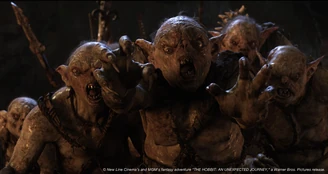
Goblins of the Loftier Pass
The Moria Orcs seen in the film seem to be larger and bulkier, towering over dwarves barrel smaller than men. The Goblins of the High Pass seen in Peter Jackson'south starting time installment of the Hobbit trilogy are quite unlike compared to the Orcs of Moria, having mankind-toned pare and riddled with various skin diseases and deformations like harelips, mismatched or skewed optics, and crooked-growing fingernails. They are overall much more than grotesque than Goblins seen in the Lord of the Rings trilogy, existence as tall as any Dwarf or Hobbit or some reaching to almost human height or even greater. These types of goblins later appear in The Hobbit: The Battle of the V Armies as "goblin mercenaries" adorned in armor and some riding War Trolls.
Advent in Peter Jackson'due south films
In Peter Jackson'south films, being of the same stature as dwarves and hobbits, the goblins are depicted in appearing to pb a much more tribal life compared to the orcs, frequently having a chief among smaller groups. Compared to orcs, goblins are less organized and use a vast range of scavenged items of vesture, armour and weaponry. They as well take a fear of light and the dominicus and will non step out in daylight most of the time.
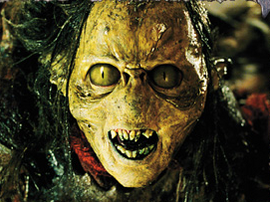
A Moria Goblin in The Fellowship of the Ring picture
There are two varieties of goblins: The goblins of the Misty Mount and the goblins of Moria. The goblins of the Misty Mountain accept flesh-colored pare and seem to be afflicted with various skin diseases and deformations that include hairlips and stunted growth. The goblins of Moria have a very green-colored pare tone compared to their Misty Mountain cousins with larger pointier ears and huge bulbous eyes that reflect their nature as cave creatures.
References
- ↑ The Hobbit, "an Unexpected Party".
- ↑ The Lord of the Rings, Appendix A, III. "Durin'due south Folk"
Source: https://lotr.fandom.com/wiki/Goblins
0 Response to "Bleach Wallpaper Hd Lord of the Rings Mines of Moria Art"
Post a Comment